


Take a quick look at the two horizontal lines in the image above. Which one seems longer? If you’re like most people, the bottom line with the outward-pointing arrows looks noticeably bigger than the one above it. To know more, check out mpbsnacks.com
Now, go ahead and measure them. Use a ruler, your finger, or even the edge of a piece of paper. Surprised? They are the exact same length. Don’t worry, your eyes aren’t broken—your brain just fell for one of the oldest and most effective tricks in the book, an illusion that works on nearly everyone.
This isn’t a glitch in your vision; it’s a feature of your brain. To make sense of the world quickly, your brain uses context clues, like how the arrows resemble the corners of a room, to make educated guesses about size and distance. Most of the time this predictive power is incredibly helpful. But sometimes, it can be delightfully fooled by clever optical illusion art.
This simple visual trick, and dozens like it, form the basis for mind-bending illusion game cards that challenge you to bet against your own eyes. These clever designs transform a simple deck into an amazing game of perception.
What Makes an “Illusion Card” Different From a Regular Playing Card?
When you picture a deck of cards, you’re likely thinking of the standard 52-card deck used for everything from Poker to Go Fish. But some decks are designed with a secret. A “gimmicked deck” is a tool for magic, where cards are physically altered—perhaps one is slightly shorter, or another has a different back—to perform a specific trick. The audience isn’t meant to know the secret; the value is in the surprise of the final reveal.
The real difference comes down to purpose and design. For our purposes, we can separate decks into three main types:
- Standard Deck: 52 unique cards for traditional games or basic magic.
- Gimmicked Deck: Specially constructed cards used to perform a specific magic effect.
- Illusion Game Deck: A set of cards where the designs create optical illusions, used for perception-based gameplay.
Unlike a gimmicked deck where a card is secretly altered, an illusion card’s trick is printed right on its face for everyone to see. There’s no hidden mechanism. The challenge isn’t finding a secret card; it’s wrestling with your own brain’s interpretation of the image. The game isn’t about fooling an audience—it’s about whether you can trust what your own eyes are telling you about something as simple as size or color.
How Your Brain Judges Size: The Forced Perspective Trick Explained
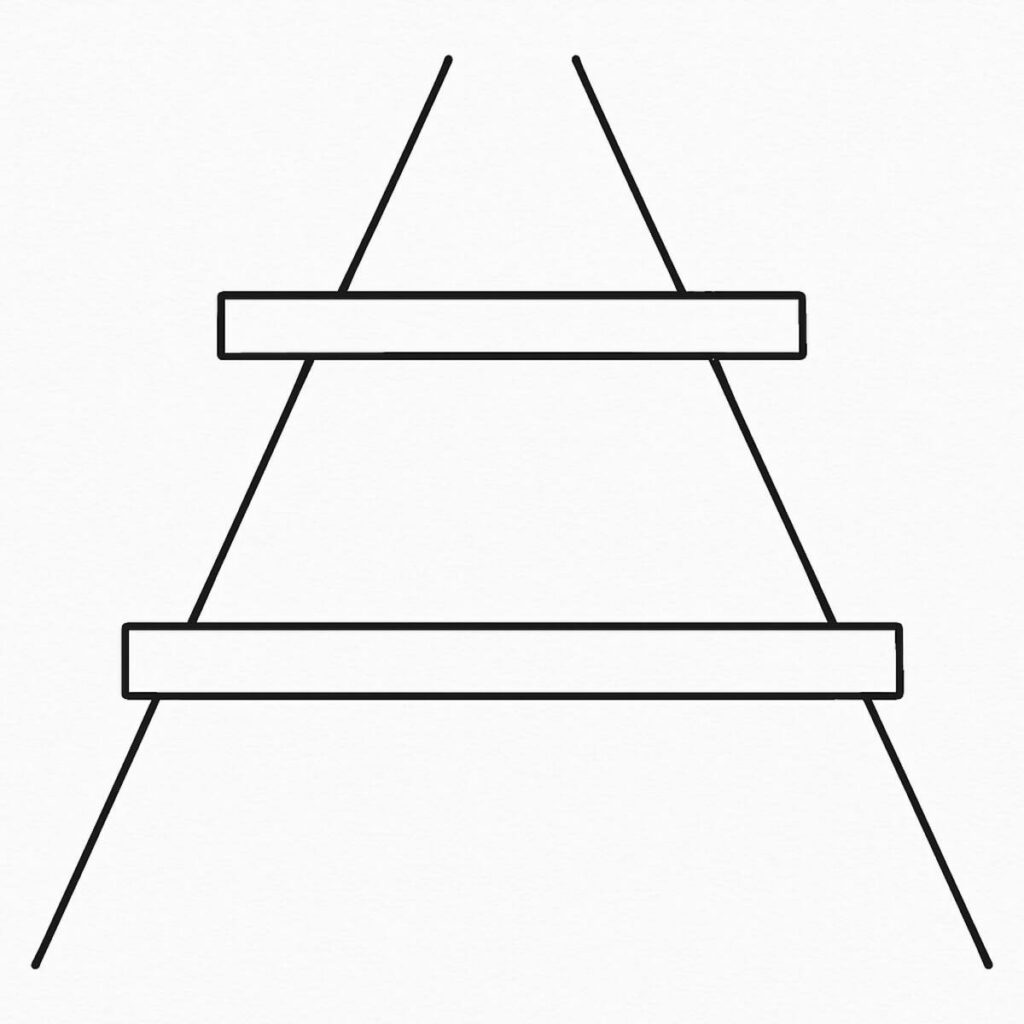
Have a look at the two horizontal bars placed on the “railroad tracks” in the image. If you’re like most people, the bar at the top, where the tracks seem to converge, looks significantly longer than the one at the bottom. Go ahead, measure them with your finger. You’ll find they are the exact same length. So, what’s going on? This is a classic visual trick, known as the Ponzo Illusion, and it plays on your brain’s deep understanding of the real world.
Your mind has learned that parallel lines, like roads or train tracks, appear to get closer together as they stretch into the distance. These converging lines are a powerful depth cue. When your brain sees them on the card, it automatically assumes it’s looking at a 3D scene. It concludes that the top bar must be “farther away” than the bottom one. From there, your brain makes a critical—and in this case, incorrect—calculation: if two objects take up the same amount of space in my vision, but one is farther away, it must be a much bigger object in reality.
This powerful principle isn’t just for cards; it’s a cornerstone of movie magic. Filmmakers use this exact technique, called forced perspective, to make miniature models look like towering monsters or to create the size difference between hobbits and humans in fantasy films. Once you understand how it works, you’ll start seeing how illusion cards cleverly use depth cues to manipulate your perception of something as basic as size.
Why This Color Looks Different: The Secret of Contrast Illusions
Size isn’t the only thing your brain gets wrong; color can be just as slippery. Picture a simple card with two backgrounds: one pitch black, the other stark white. If you place an identical gray square in the center of each, a strange thing happens. The gray on the black background appears much lighter, almost glowing, while the gray on the white background looks dull and dark. Yet, if you were to isolate those two gray squares, you’d find they are the exact same shade.
This isn’t a flaw in your vision but rather a feature of how your brain processes information. Our minds don’t see colors in a vacuum; they judge them in relation to what’s around them. To help you distinguish objects more clearly, your brain automatically enhances the difference—or contrast—it perceives. Against a dark background, it “brightens” the gray square to make it pop. This powerful effect, a core principle in optical illusion art card sets, is known as the Simultaneous Contrast Illusion.
This principle is a key element in many visual paradox card games. Designers intentionally use this illusion to create doubt. A game might ask you to judge which of two cards has “more blue,” but by surrounding the blue areas with different, carefully chosen colors, they make a simple visual task feel impossibly difficult. You’re no longer just playing the game; you’re battling your own brain’s automatic assumptions.
The Svengali Deck: Perform Mind-Blowing Magic With Zero Sleight of Hand
While some illusions trick your eyes with clever art, others rely on a secret you can hold right in your hands. For anyone who’s ever wanted to perform card magic that requires no sleight of hand, the Svengali deck is the ultimate tool. From the outside, it looks like any other deck, but its hidden construction does all the difficult work for you, making you look like a master magician with minutes of practice.
So, what is a Svengali deck? The secret is brilliantly simple: half the cards in the deck are slightly shorter than the other half. Crucially, all of these short cards are identical—this is your force card. Because of the different lengths, how you handle the deck changes what people see. If you riffle the cards from one direction, your thumb catches on both long and short cards, showing a normal, mixed deck. Riffle from another, and you’ll only catch the short cards, making it look like the entire deck is made of the single force card.
This clever design allows you to perform incredible, multi-phase tricks. Here is a classic illusion you can learn right now:
- Show the Deck: Hold the deck and casually riffle the corners to show your friend the faces of many different cards.
- Force the Card: Ask them to say “stop” as you riffle the cards again, but this time, do it in a way that lets them see one of the short force cards.
- Lose the Card: Let them place their card back anywhere in the deck. The magic is already done.
- The Reveal: Announce that you’ll make their card jump to the top. Snap your fingers, turn over the top card, and reveal their chosen card waiting for them.
The power of a deck like this is undeniable for beginners, creating clean, baffling effects with zero difficult moves. This success, however, naturally leads to the next question for any aspiring performer: when should you use a gimmicked deck versus a standard one?
Gimmicked vs. Standard Decks: Which Is Right For You?
Choosing between a gimmicked deck like the Svengali and a standard 52-card pack is really about your goal. A trick deck is a shortcut, designed to produce one or two spectacular effects with almost no practice. It’s perfect for baffling your friends at a moment’s notice. However, its magic is limited to the secret it holds, and once an audience suspects the cards are “special,” the illusion can lose its power. The deck does the work, but it can only perform its one programmed routine.
A standard deck, on the other hand, holds limitless potential, but it demands something more from you: skill. This is the world of sleight of hand—the art of manipulating objects secretly. Learning to handle a normal deck with grace allows you to create countless illusions that aren’t tied to a single gimmick. The magic isn’t in the cards; it’s in your hands. This journey from fumbling shuffles to flawless fans is much harder, but the reward is true mastery and the ability to perform miracles with any deck you’re handed.
Ultimately, the choice is yours. If your goal is to have a fantastic, ready-to-go trick for a party, a gimmicked deck is an unbeatable option for beginners. But if you’re drawn to the art of magic itself, the long but rewarding path of learning sleight of hand offers endless possibilities.
From Trick to Gameplay: How the ‘Illusion’ Game Turns Your Brain Against You
What if the trick wasn’t hidden, but was the entire point of the game? That’s the fascinating premise behind perception-based games like the popular title Illusion. Instead of relying on sleight of hand, these games use optical illusion art card sets to directly challenge what you see. The contest isn’t about outsmarting an opponent with logic; it’s about betting on whether you can trust your own brain.
The rules are deceptively simple. An arrow dictates a color—say, blue—and you must play a card from your hand into a growing line-up. You place it where you think it fits based on the percentage of blue it contains. Does your card have more blue than the one before it, but less than the one after? This simple question becomes incredibly difficult when the artwork is designed to mislead you.
Here, the illusion game cards weaponize the visual tricks you’ve already seen. A small patch of blue might be placed against a contrasting color to make it pop, while a much larger blue area is broken up by distracting patterns to make it seem smaller. Remember how surrounding objects can warp your perception of size? The game uses those exact principles, turning a simple color check into a maddening visual paradox.
The fun peaks when someone finally doubts the line-up. By challenging the order, you force a reveal: everyone flips the cards to see the true percentages on the back. The collective groans and laughter when you discover how badly your eyes fooled you is the game. It’s a humbling experience proving seeing isn’t always believing, and it creates shareable moments of disbelief perfect for any party—or your social media feed.
How to Make Your Illusion Cards Go Viral on Social Media
Those jaw-dropping moments of disbelief are practically designed for short-form video. The good news is, you don’t need fancy editing skills to create compelling card tricks for social media videos. Most viral clips follow a simple 15-second playbook that hooks the viewer, delivers a payoff, and encourages a rewatch.
Your recipe for a perfect illusion video has just three steps:
- The Setup (3 sec): Start with a tight shot of the illusion in its most deceptive state. Ask a question in your caption like, “Which circle is bigger?”
- The Reveal (7 sec): This is the star of the show. Slowly move the camera or slide the cards to expose the trick. A slow, smooth motion that makes the illusion “break” is incredibly satisfying to watch.
- The Reaction (5 sec): Hold on the final, “true” state of the cards with text like “My brain just melted 🤯” to give viewers a moment to process what they saw.
The most crucial element is a clean, undeniable reveal. Illusions that involve movement or changing angles are video gold for this reason. A fantastic type to look for is the anamorphic illusion—an image that looks like a warped, stretched-out mess until you view it from a very specific, low angle. Performing tricks with these perspective cards is perfect for a video, as a slow tilt of your phone can make a jumbled shape dramatically snap into a clear picture. Size illusions are also effective, as you can physically move the “smaller” object next to the “bigger” one to prove they’re identical. Once you start filming, you’ll want to keep these special decks looking sharp for their close-up.
The Right Way to Care For Your Special Decks
After wowing your friends, your deck’s best friend is the box it came in. This little cardboard home, called a tuck case, is the number one defense against the elements. Humidity and pressure are the enemies of paper, causing card warping—that frustrating curve that makes cards difficult to handle and can ruin certain illusions. Always sliding them back into their case keeps them flat, protects the edges from fraying, and ensures they’re ready for their next performance.
When it comes to shuffling, one popular move is strictly off-limits. Avoid the flashy bridge shuffle, where you bend both halves of the deck upwards and let them ripple together. While it looks professional, that deep bend puts a permanent crease in the cards. Many illusion decks, like a Svengali deck, rely on the cards being perfectly uniform, and a single shuffle like this can instantly break the gimmick and destroy the magic.
Finally, the simplest rule is often the most important: handle your cards with clean, dry hands. The oils and dirt from your fingers can slowly build up, creating subtle smudges that act like unintentional marks. On a card designed to fool the eye with precise colors and lines, a greasy fingerprint can be the one detail that gives the whole game away. Keeping your tools pristine is the first step in protecting the secret, allowing these cards to effectively play their tricks on our perception.
More Than a Trick: What Illusion Cards Teach Us About Our Minds
You began this journey expecting a simple trick, but you’re leaving with the blueprint to the funhouse. Where you once saw a bewildering effect, you can now spot the forced perspective, the color contrast, and the clever assumptions your brain makes automatically. The fun is no longer just experiencing the illusion; it’s being in on the secret of how it works.
This secret language is everywhere. It’s the engine behind mind-bending optical illusion art and the core of the misdirection that makes great card magic feel so impossible. The same rules that power these simple illusion game cards are what artists and magicians use to command your attention and playfully hack your perception.
Your first mission, should you choose to accept it, is to start noticing these principles in the wild. The next time you see a company logo with a clever use of negative space or walk down a long hotel hallway that seems to shrink, pause for a moment. Ask yourself: “What shortcut is my brain taking right now?” Each time you spot one, you’ll build your confidence in seeing the world with a more discerning eye.
Ultimately, these cards reveal that being “fooled” is not a sign of failure, but a testament to your brain’s incredible efficiency. You now see that the true magic isn’t on the card; it’s the quick, clever, and sometimes comical way your own mind works. You haven’t just learned about illusions—you’ve been properly introduced to your own perception.