


Back in the mid-1990s, a card game revolution was sweeping across game stores and kitchen tables. As giants like Magic: The Gathering established the rules of fantasy combat, a new challenger took flight, betting everything on the single most iconic creature in all of mythology. It was a game focused entirely on the thrill of commanding an empire of scales, claws, and fire. The Interesting Info about riauterdepan.com.
That game was the Wyvern trading card game, a unique creation from veteran designer Mike Fitzgerald. In an era where many titles were exploring vast, complex worlds, Fitzgerald’s design focused with laser precision on a singular, powerful theme. This produced one of the most memorable dragon-themed collectible card games of its time, where every card served the core fantasy of raising a hoard of mythical beasts.
What truly set Wyvern apart, however, was its strategic objective. Imagine winning a card game not by slowly chipping away at an opponent’s health, but by launching a targeted, decisive strike against their single most powerful ‘king’. This is the central challenge of Wyvern, where your entire strategy builds toward breaking through enemy lines to defeat one specific, legendary dragon guarding their hoard.
This guide explains the simple foundations of Mike Fitzgerald’s game design for Wyvern, covering its goal, core cards, and basic rules from the ground up. No previous card game experience is necessary—just a curiosity for how you, too, can become the ultimate dragon master.
The Core Quest: How Do You Actually Win in Wyvern?
In many battle games, the goal is total annihilation. Wyvern, however, focuses the conflict on a single, epic objective. It’s less about winning a war of attrition and more about executing a perfect royal takedown.
Wyvern channels this drama through a special card called the Dragon Lair. At the start of the game, each player chooses one of their Dragons to be their champion and places it in this lair. This Dragon is now your king, and the Lair is its castle. To win the game, you must break through your opponent’s defenses, attack their Dragon Lair, and defeat the specific Dragon defending it.
This “king of the hill” design creates a fascinating tug-of-war. Every decision you make must balance offense and defense. Do you send your best attacker to assault the enemy’s Lair, or keep them back to protect your own champion? This focused objective gives every match a tense, personal feel. But to attack or defend, you’ll first need an army.
Meet Your Dragon Army: The Four Essential Card Types
An army is more than just its soldiers, and in Wyvern, your deck is your entire war machine. To succeed, you’ll need to manage four distinct types of cards, each with a crucial job. Think of them as the different departments of your kingdom: your treasury, your warriors, your fortifications, and your book of surprise tactics.
Everything begins with your treasury. Before you can unleash fire-breathing beasts, you need to pay for them. This is the job of Treasure cards. Each turn, you can play one of these from your hand to build up your hoard of Gold, the game’s primary resource. Without a steady income from your Treasure cards, your mighty dragons remain stuck in your hand.
Once your treasury has some Gold, you can start spending it. Dragon cards are the heart of your army, serving as your attackers and defenders. You’ll also use Gold to establish Terrain cards, which act like fortresses to protect your Dragon Lair or provide other powerful benefits. Finally, Action cards are one-time events—like a sudden ambush or a magical shield—that can instantly turn the tide of a fight when you pay their Gold cost.
The best starting deck isn’t about a single card, but a balanced mix of all four types. A hand full of powerful Dragons is useless without the Gold to play them, and a mountain of Gold is pointless without an army to spend it on. Building a deck is an art of balance.
What’s a Dragon’s ‘Power’?: How to Read a Wyvern Card
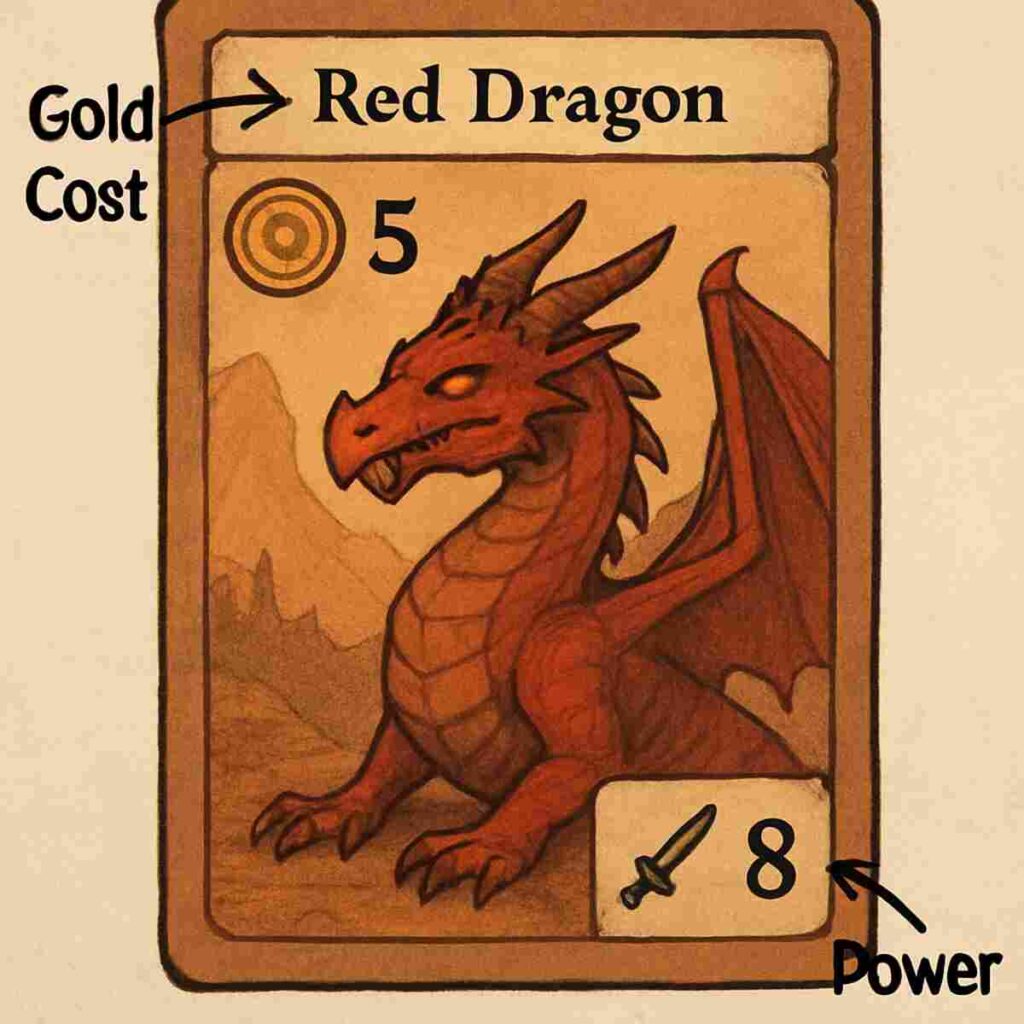
Let’s zoom in on the most important cards: your Dragons and the Treasures that pay for them. Every Dragon card features two critical numbers that tell you its story at a glance. As shown on the “Red Dragon” card below, the number next to the gold coin icon is its Gold Cost—think of this as its price tag. The number beside the sword icon is its Power, which is its raw strength in battle. A powerful Dragon might win any fight, but its high Gold Cost means you’ll need a wealthy treasury to even get it onto the battlefield.
Building that treasury involves your Treasure cards and a key game mechanic called tapping. When you want to use a card for its primary ability—like getting gold from a Treasure card—you turn it sideways. This is known as “tapping” the card, and it’s a simple visual cue that the card has been used for the turn. Each turn, you can tap your Treasure cards on the table to add their gold value to your hoard.
This simple loop is central to gameplay. You spend early turns playing Treasure cards, and then on later turns, you tap them to accumulate the gold needed to summon a mighty Dragon. If that “Red Dragon” costs 5 gold, you’ll need to have enough tapped Treasure to afford it. Mastering the relationship between Gold Cost, Power, and tapping is the foundation for every move you’ll make.
Your First Battle Plan: A Step-by-Step Guide to a Turn
Every turn in Wyvern follows the same three basic steps. This predictable rhythm helps you plan your strategy from the moment you draw your first hand, turning a handful of cards into a coherent plan of attack.
Think of each turn as executing your battle plan. The sequence is always the same:
- Get Resources: Play one Treasure card from your hand onto the table. This is a strict rule—you can only build your economy by one Treasure per turn!
- Deploy Forces: Use your total available gold to play Dragon or Terrain cards from your hand.
- Take Action: Declare an attack with one of your ready (untapped) Dragons.
How gold works is a key rule. When you “spend” gold to play a Dragon, you aren’t discarding your Treasure cards. You just need to have enough Treasure on the table to meet the cost. If a Dragon costs 5 gold, you simply need Treasures that produce at least 5 gold. They stay right where they are, ready to contribute to your wealth again next turn.
This core loop is the secret to building a strong deck. You must include enough Treasure cards to build your economy in the early turns; otherwise, your most powerful dragons will remain stuck in your hand. Once your army is on the field, though, it’s time for battle.
When Dragons Clash: How Combat Works in a Duel
That final step of the turn, taking action, is where the fire and fury begins. To attack, you simply choose one of your Dragons on the table that isn’t already turned sideways and tap it. This declares your attack! Your target is always the same: your opponent’s main Dragon Lair. You are sending your warrior to challenge their king directly, and every attack is a direct threat to winning the game. The pressure is now on your opponent to respond.
Facing an incoming Dragon, the defending player has a critical choice. They can either let the attack through and take the hit, or they can choose one of their own untapped Dragons to intercept and block. This creates a dramatic one-on-one duel. Unlike the often complex combat of other TCGs, battles in Wyvern are swift and decisive. The defender must weigh whether it’s worth risking one of their own valuable Dragons to protect their Lair.
If a block happens, the two Dragons fight. The resolution is simple: compare the Power stat of each Dragon. The one with the lower Power is defeated and becomes “stunned”—it is turned sideways and cannot be used again until its owner untaps it at the start of their next turn. Crucially, the winning Dragon takes no damage at all. This simple but brutal system means having dragons of varying strengths for both attacking and blocking is essential.
Building Your Hoard: The Simple Secret to a Good Wyvern Deck
The game you play before the real game even starts is deck building. Think of it like assembling an army: you need more than just powerful soldiers. You also need a treasury to pay them and a supply line to support them. In Wyvern, this means finding the right balance between your fearsome Dragon cards and the essential Treasure cards that bring them onto the battlefield.
The danger of a poorly balanced deck becomes obvious very quickly. If you stuff your deck with only the biggest, strongest dragons, you’ll often find yourself with a hand full of incredible power but no gold to play any of it. This is why when starting out, some of the most important cards are the humble, reliable treasures. They ensure your mighty beasts can actually join the fight.
A standard Wyvern deck contains exactly 60 cards. The art of building a good deck involves carefully selecting those sixty cards from the game’s entire library. This curation of resources, fighters, and surprise actions is what makes each player’s army unique.
Dragon Kings vs. Planeswalkers: How Wyvern Differs from Magic: The Gathering
For anyone familiar with trading card games, one name looms large: Magic: The Gathering. So, how does a game like Wyvern stand apart? The most immediate difference is thematic focus. While Magic explores a vast multiverse, Wyvern is one of the most dedicated dragon-themed card games ever made. Every battle is a clash of dragons, giving the game a distinct and powerful identity.
Perhaps the biggest difference lies in how you win. Most TCGs, including Magic, give each player a life total that opponents try to reduce to zero. Wyvern throws that idea out entirely. Instead, your goal is to break through defenses and defeat the one specific Dragon guarding their Dragon Lair. This makes every match feel less like a brawl and more like a strategic siege on the enemy’s king.
This unique objective is fueled by a different approach to resources. Wyvern players build up a permanent bank of gold by playing Treasure cards. This contrasts with Magic’s famous land system, where players use land cards to generate a temporary pool of energy, or “mana,” that resets each turn. Wyvern’s system of hoarding gold feels wonderfully appropriate for a game about dragons guarding their treasure.
These design choices give Wyvern its own unique flavor, setting it apart as one of the more interesting vintage card games of the 90s.
Are Old Wyvern Cards Worth Anything? Unlocking Their Collector Value
With these classic cards now decades old, a natural question is whether they are worth anything. The answer lies in rarity. Like coins or comic books, not all Wyvern cards were created equal. To see what you have, look for a small circle on the card containing a single letter: ‘C’ stands for Common, ‘U’ for Uncommon, and ‘R’ for Rare. A card with an ‘R’ was much harder to find in a booster pack than one with a ‘C’.
Adding another layer of excitement, Wyvern included special ‘Gold Foil’ cards. These are versions of regular cards that feature a stunning, metallic gold border and text box. Because they are so scarce and visually striking, the value of a Gold Foil card is significantly higher. Even a normally common Dragon becomes a prized collectible if it’s a Gold Foil.
Of course, rarity and foiling only matter if the card is in good shape. Just like with any vintage collectible, condition is king. A card with sharp corners, a clean surface, and no bends is considered ‘Near Mint’ and will command a much higher price than a ‘heavily played’ one with creases and worn edges. A pristine Rare can be a treasure, while the same card with significant damage might be worth very little.
Where to Hunt for Dragons: Buying Wyvern Cards Today
Armed with the knowledge of what makes a card valuable, you’re ready to start your own hoard. Since the game is long out of print, your local game store won’t have booster packs on the shelf. The primary place to buy old Wyvern cards is online. Marketplaces like eBay are a treasure trove for these ’90s collectibles, where sellers from around the world list everything from single cards to entire collections.
When you begin your search, you’ll notice listings are typically sold in two ways: as “lots” or as “singles.” A card “lot” is a bulk package containing dozens or even hundreds of cards, often for a very reasonable price. For someone new to the game, this is usually the best way to start. It’s an instant collection, giving you a wide variety of cards to explore and build your first decks with.
In contrast, buying “singles” is a more focused approach. This means purchasing one specific card at a time. Once you have a collection started and realize you’re missing that one perfect Dragon or a powerful Treasure card, buying it as a single is the most direct way to get it. Both methods are great, but they serve different moments in your collecting journey.
Your Journey as a Dragon Master Begins
You’ve just journeyed into a classic of the 90s TCG boom. Where before you might have seen a forgotten box with a dragon on it, you can now visualize the entire battlefield. You understand the objective isn’t just to fight, but to lay siege to your opponent’s main Dragon. You recognize the roles of your army—the Treasures that fund it, the Dragons that form it, the Terrains that defend it, and the Actions that create surprise turnabouts.
This elegant focus is the enduring charm of the Wyvern trading card game. It doesn’t ask you to learn a decade of lore; it simply invites you to command dragons. This direct-but-deep strategy is what sets it apart. The game’s appeal lies in mastering a straightforward set of rules to execute a clear, compelling mission: protect your hoard and conquer the enemy’s lair.
Reading about the rules is one thing, but seeing them in motion is where the magic truly ignites. To bring your new knowledge to life, your next step is simple: watch a game unfold. Head over to YouTube and search for “how to play Wyvern CCG” or “Wyvern TCG gameplay.” Watching just one match will connect all the concepts you’ve learned and show you how these cardboard dragons truly take flight.