


The e-commerce landscape is shifting rapidly, and if you are building or scaling an online store, sourcing reliable suppliers is the backbone of your success. For years, Asia has been the undisputed powerhouse of product sourcing. However, with evolving global logistics, changing trade regulations, and rising consumer expectations, finding the absolute best partners is more critical than ever. What do you need to consider about dropshipping from china.
In this comprehensive guide, we will explore the Top Chinese Dropshipping Sites for 2023. We will break down exactly how to navigate these platforms, compare their features, and provide actionable strategies to build a resilient, highly profitable dropshipping business.
The Elephant in the Room: Is Dropshipping from China Still Profitable?
Before we dive into the platforms, we need to address a common question echoing through e-commerce forums and social media: is dropshipping from China still profitable in 2023?
The short answer is an absolute yes. However, the methods that worked in 2016 will no longer cut it today. Consumers are no longer willing to wait 45 days for a generic, unbranded product arriving in a crushed ePacket envelope.
Today’s profitability relies heavily on three core pillars:
- Strategic Sourcing: Moving beyond saturated marketplaces and finding niche-specific suppliers.
- Upgraded Logistics: Utilizing premium shipping lines instead of legacy budget options.
- Brand Building: Treating dropshipping as a fulfillment method, not a business model, by adding perceived value through branding, excellent customer service, and high-quality content.
When you master these three elements, dropshipping from china remains one of the most lucrative, low-barrier entry points into global e-commerce. China still boasts unparalleled manufacturing infrastructure, incredibly competitive pricing, and a rapidly modernizing fulfillment network designed specifically for global dropshippers.
Part 1: The Top Chinese Dropshipping Sites for 2023
Choosing the right supplier platform is the first major decision you will make. Below, we review the absolute best dropshipping platforms originating from Asia, highlighting their unique strengths, ideal use cases, and exactly how they fit into a modern e-commerce strategy.
1. AliExpress: The Undisputed Giant
It is impossible to talk about the Top Chinese Dropshipping Sites for 2023 without starting with AliExpress. As the B2C arm of the Alibaba Group, AliExpress features millions of products across every conceivable niche.
Pros:
- Massive Product Catalog: If a product exists, it is likely on AliExpress.
- Low Barrier to Entry: No minimum order quantities (MOQs), making it perfect for testing new products.
- Buyer Protection: A robust dispute system that generally favors the buyer if items arrive damaged or not as described.
Cons:
- Inconsistent Quality: Because anyone can sell on the platform, quality varies wildly from vendor to vendor.
- Communication Barriers: Many sellers rely on translation software, which can make complex negotiations difficult.
- Saturated Products: Winning products scale so quickly that they become saturated fast.
Best For: Beginners looking to test product concepts quickly before committing to bulk inventory.
2. CJ Dropshipping: The Modern Innovator
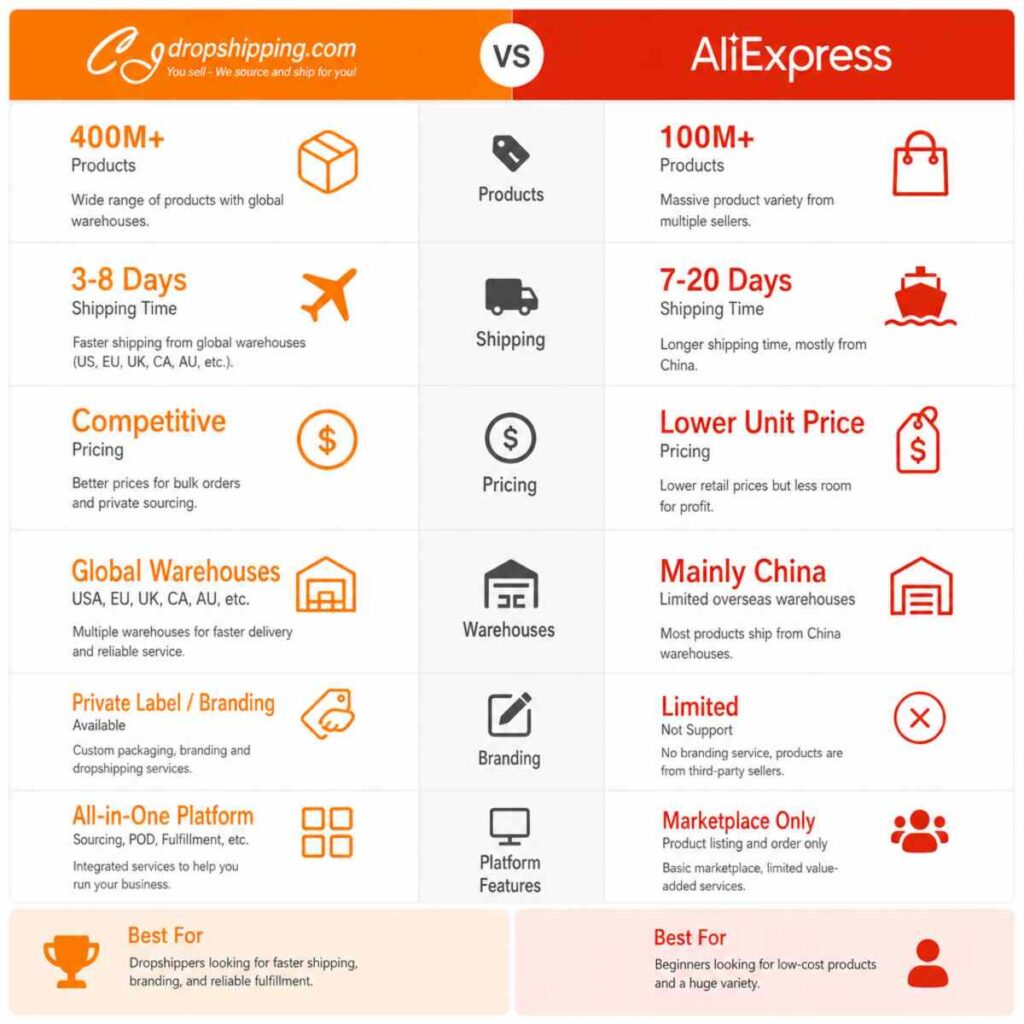
If you are looking for the best chinese dropshipping site specifically tailored to the needs of modern e-commerce entrepreneurs, CJ Dropshipping often takes the crown. Unlike AliExpress, which is a marketplace of independent sellers, CJ Dropshipping operates as a massive fulfillment partner.
When looking at CJ Dropshipping vs AliExpress for beginners, CJ offers several distinct advantages. First, they source the products for you. If you find a product on AliExpress, you can submit an image or link to CJ, and their team will source it, often at a better price. Second, they offer global warehouses, custom packaging, and print-on-demand services.
Pros:
- Print-on-Demand & Custom Packaging: Easily transition to a branded feel.
- Sourcing Services: They will find products not currently in their catalog.
- Quality Control: CJ inspects products before they are shipped out.
Cons:
- User Interface: The platform can feel overwhelming and slightly clunky for brand-new users.
- Processing Times: While shipping is fast, processing sourced products can take a few days if they are not housed in CJ’s immediate warehouse.
3. Alibaba: The B2B Behemoth
While historically known for massive bulk orders, Alibaba has increasingly adapted to the dropshipping market through its Dropshipping Center.
DHgate vs Alibaba for small business: This is a common debate. While DHgate is excellent for small bulk orders (think 10-50 units), Alibaba is ultimately better for long-term scalability. Alibaba allows you to speak directly to the manufacturers, opening the door for product customization, custom molds, and deep discounts as your volume grows. Alibaba’s Trade Assurance also provides a highly secure payment environment.
Pros:
- Direct-to-Manufacturer: Lowest possible pricing.
- Customization: The best platform for transitioning from standard dropshipping to private labeling.
Cons:
- MOQs: Many sellers still require Minimum Order Quantities, though this is changing.
- Negotiation Required: You must actively communicate to get the best deals and terms.
4. Made-in-China: The B2B Dark Horse
Made-in-China is often overlooked by dropshippers, but it is an absolute goldmine for heavier items, industrial goods, electronics, and unique niches.
Finding winning products on Made-in-China requires a different approach than scrolling through consumer apps. You want to look for medium-to-large manufacturers that hold certifications (such as ISO 9001) and are willing to negotiate “sample” orders to be sent directly to your customers. It is exceptional for high-ticket dropshipping (e.g., e-bikes, specialized machinery, or premium furniture).
Pros:
- High-Ticket Items: Excellent for finding expensive, high-margin products.
- Verified Suppliers: The platform has a strict auditing process for its premium suppliers.
Cons:
- Not Built for Automated Dropshipping: You will likely need to process orders manually or via CSV files with the supplier.
5. DHgate: The Bulk and Replica Alternative
DHgate sits somewhere between AliExpress and Alibaba. It is a marketplace where you can buy a single item, but you get significant discounts if you buy a small carton. It is highly popular for small electronics, apparel, and accessories.
A note of caution: DHgate is notoriously rife with counterfeit goods and brands. Ensure you strictly avoid branded items to prevent legal action and payment gateway bans on your store.
6. Banggood: The Electronics Specialist
Banggood operates similarly to AliExpress but focuses heavily on its own curated supply chain rather than third-party sellers. They specialize in electronics, RC toys, 3D printers, and gadgets. Because they manage their own inventory across global warehouses (including the US and EU), they offer much more reliable shipping times for these specific niches.
Part 2: Finding the Best AliExpress Alternatives for Dropshipping
Relying solely on AliExpress is a risky strategy for long-term growth. Because it is a B2C platform, you are essentially buying at retail (or near-retail) prices and marking them up. To truly scale, you need to find the best AliExpress alternatives for dropshipping that offer wholesale pricing and better logistical support.
The Rise of Dedicated Fulfillment Agents
Beyond platforms like CJ Dropshipping or Banggood, the ultimate alternative to AliExpress is using professional sourcing agents in China.
A sourcing agent is an individual or a company located in China that acts on your behalf. You tell them what you need, and they go directly to the factories (often in cities like Yiwu, Guangzhou, or Shenzhen) to negotiate prices, oversee production, check quality, and manage fulfillment.
When should you switch to an agent? Typically, you should transition to a private agent once you are consistently hitting 10-20 orders per day of a single product.
Benefits of a Sourcing Agent:
- Cheaper Product Costs: Agents buy directly from factories off the 1688.com platform (China’s domestic wholesale site), bypassing English-speaking markup platforms.
- Consolidated Shipping: If a customer buys three different items, an agent can pack them into one box. AliExpress would send three separate packages, confusing the customer.
- Daily Communication: You communicate via WhatsApp, Skype, or WeChat to get real-time updates and videos of your inventory.
Part 3: Mastering Logistics and Shipping
If there is one factor that will make or break your dropshipping store in 2023, it is shipping times. Consumers conditioned by Amazon Prime simply will not tolerate month-long waits. You must master China dropshipping shipping times and logistics.
The Death of ePacket
For years, dropshippers relied on ePacket—a subsidized shipping agreement between the US Postal Service and China Post. However, due to changing international postal treaties and the aftermath of global supply chain disruptions, ePacket is no longer the fastest or most reliable option. In fact, relying on it today is a recipe for chargebacks.
Exploring ePacket Alternatives for Fast Global Delivery
To succeed, you must utilize “Special Line” shipping options. These are private freight forwarders who charter cargo flights, fly the goods to the destination country, clear customs in bulk, and then hand the packages off to local couriers (like USPS in America or Royal Mail in the UK) for the “last mile” delivery.
Here are the top ePacket alternatives for fast global delivery:
- YunExpress: Arguably the most reliable special line for dropshippers. They consistently deliver to the US, UK, and major European countries in 6 to 12 days. They offer end-to-end tracking that integrates seamlessly with Shopify.
- CNE Express: Highly competitive with YunExpress, offering fantastic rates for lightweight parcels and delivery times often sitting around 7-10 days to Europe.
- Yanwen: A massive logistics provider. Be sure to ask your supplier for “Yanwen Special Line” (not their economic untracked service). It is highly efficient for global routing.
- 4PX: Excellent for products containing batteries (which are notoriously difficult to ship via standard airmail) and offers robust tracking.
Overcoming Long Shipping Delays from Asia
Even with premium shipping lines, delays happen (holidays, customs checks, weather). Overcoming long shipping delays from Asia requires a proactive approach:
- Set Clear Expectations: Do not lie on your website. If shipping takes 8-14 days, state clearly on your product page and checkout screen: “Please allow 8-14 business days for tracked delivery.” Customers don’t mind waiting if they are informed; they mind being deceived.
- Automate Tracking Updates: Use apps like AfterShip or ParcelPanel. These send automated email or SMS updates to your customer every time the package reaches a new checkpoint.
- Strategic Pre-Ordering: As you scale, consider holding a small amount of inventory (e.g., 200 units) in a 3PL (Third-Party Logistics) warehouse in your primary target country. You dropship from China for the rest of the world, but offer 2-day domestic shipping for your biggest market.
Part 4: Quality Assurance and Supplier Vetting
A beautiful website and fast shipping mean nothing if the product arrives broken or fails after one use. Managing quality control with international vendors is a non-negotiable skill.
How to Verify Chinese Supplier Credentials
Do not take a supplier’s word at face value. Before making them the backbone of your supply chain, you must vet them thoroughly.
- Check Business Licenses: Legitimate Chinese companies have a registered 18-digit business license number. You can request a copy of their license and verify it through China’s National Enterprise Credit Information Publicity System (NECIPS).
- Examine the Business Name: Chinese company names follow a strict legal structure: [City/Province] + [Company Name] + [Industry] + [Company Type]. For example, Shenzhen TechNova Electronics Co., Ltd., if you are looking for a manufacturer but the industry says “Trading”, they are a middleman, not a factory.
- Look for Certifications: Depending on your niche, ask for CE, RoHS, FDA, or ISO 9001 certificates. Ensure the name on the certificate matches the name on their business license.
- Analyze Transaction History: On platforms like Alibaba, look at the supplier’s “Trade Assurance” history. Are they consistently doing hundreds of thousands of dollars in revenue? Do they have a high on-time delivery rate?
The Sample Testing Protocol
Never start running ads to a product without testing it yourself first.
- Order from 3 Different Suppliers: If you find a winning product, order a sample from three competing factories.
- Evaluate the Unboxing Experience: Did the box arrive crushed? Was there weird Chinese text or competitor branding on the packaging?
- Stress-test the Product: Use it as a consumer would. If it’s a kitchen gadget, wash it ten times. If it’s electronic, leave it plugged in. Identify the failure points so you know what customer service inquiries to expect.
- Test the Shipping Speed: Track exactly how long it took from the moment you clicked “pay” to the moment it arrived at your door.
Part 5: Tech and Automation
To run a profitable e-commerce business, you cannot spend your days manually typing customer addresses into a Chinese supplier’s website. You need to leverage technology for seamless operations.
Integrating Shopify with Chinese Wholesale Platforms
Shopify remains the gold standard for dropshipping storefronts, and connecting it to your suppliers has never been easier. The goal of integrating Shopify with Chinese wholesale platforms is to create a seamless loop: a customer buys from your store, the order is automatically forwarded to your supplier, the supplier ships it, and the tracking number is automatically pushed back to your Shopify store and emailed to the customer.
Automated Order Fulfillment Software for China
To achieve this loop, you need robust middleware. Here are the top tools for automated order fulfillment software for China:
- DSers: The official partner for AliExpress. DSers allows you to map variants, bundle products, and place hundreds of orders to AliExpress with a single click. It is incredibly powerful for volume processing.
- AutoDS: A fantastic all-in-one tool that not only automates fulfillment from AliExpress, CJ Dropshipping, and Banggood but also includes automated price and stock monitoring. If your Chinese supplier runs out of a blue t-shirt, AutoDS will automatically mark it out of stock on your Shopify store so you don’t sell products you can’t fulfill.
- Zendrop: A heavily curated platform that connects directly to your store. While slightly more expensive, Zendrop limits its catalog to pre-vetted, high-quality Chinese suppliers and offers automated fulfillment and fast shipping lines built directly into their app.
Step-by-Step Integration Example (using DSers & Shopify):
- Install the DSers app from the Shopify App Store.
- Link your DSers account to your AliExpress buyer account.
- Use the DSers Chrome Extension to import products directly from AliExpress into your DSers dashboard.
- Edit the product title, description, and pricing in DSers, then push the changes to your Shopify store.
- When a customer purchases, go to DSers, select Open Orders, and click “Place Order.” DSers will bulk-pay AliExpress and automatically sync the tracking once the supplier ships.
Part 6: Transitioning from Dropshipping to Brand Building
Dropshipping is an incredible way to validate a product and gather a customer base without upfront inventory risk. However, true wealth in e-commerce is generated by building a brand asset that you can eventually sell.
Private Label Manufacturing for Dropshippers
Once you have proven a product works (e.g., selling 50+ units a day), it is time to transition from dropshipping generic items to private label manufacturing for dropshippers.
- White Labeling: The factory takes their existing, generic product and simply prints your logo on the product and the packaging. This is relatively inexpensive and usually requires an MOQ of only 100-500 units.
- Private Labeling (OEM): You work with the factory to actually alter the product. This might mean changing the materials, upgrading the battery, or altering the physical mold to make it completely unique. MOQs are usually higher (1000+ units), but they completely protect you from competitors selling the generic version.
Alibaba is the premier platform for initiating this transition. You can use your sales data to negotiate confidently with suppliers: “I have sold 3,000 units of this generic item in the last 60 days. I want to transition my supply chain to your factory, but I need custom packaging and my logo etched onto the glass. What is your MOQ and unit price?”
By moving to private label, you increase the perceived value of your product, allowing you to charge premium prices. It also significantly increases your customer return rate, as buyers are receiving a premium, branded unboxing experience rather than a generic parcel.
Part 7: Navigating the Legal and Financial Complexities
As your business grows internationally, you will inevitably run into the bureaucratic side of e-commerce. You cannot afford to be ignorant of international trade laws.
Customs Duties and Import Taxes Guide
When you dropship from China to global customers, you are acting as an importer of record (or your customer is, depending on how things are structured). Understanding a customs duties and import taxes guide is vital to prevent angry customers from receiving surprise tax bills at their door.
Understanding DDP vs. DDU:
- DDU (Delivered Duty Unpaid): The default for cheap shipping. The package arrives in the destination country, and if customs flags it for taxes, the customer must pay before the post office will release it. This leads to massive customer complaints and refused packages.
- DDP (Delivered Duty Paid): The freight forwarder or supplier pays the customs duties at the border, and bills you (the merchant) for the cost upfront. The customer receives the package seamlessly. Always ask your supplier or agent to ship via DDP lines.
Navigating Regional Taxes:
- The United States: The US has highly favorable import laws for dropshippers. The De Minimis threshold is currently $800. This means that any individual shipment valued under $800 enters the US duty-free. Since 99% of dropshipped packages are under this value, US customers rarely face import duties.
- The European Union (IOSS): The EU recently changed its VAT laws. All imports into the EU are now subject to Value Added Tax (VAT), regardless of value. To prevent packages from being held up, dropshippers should register for the Import One-Stop Shop (IOSS).
- How it works: You collect the VAT from your European customer at checkout on your Shopify store. You then provide your IOSS number to your Chinese supplier. The supplier puts this number on the electronic customs declaration. When the package hits European customs, they scan it, see that VAT has already been collected, and let it pass instantly. You then remit the collected VAT to the EU monthly.
- The United Kingdom: Similar to the EU, the UK requires you to register for a UK VAT number and collect a 20% VAT at checkout for orders under £135.
Handling these taxes properly is what separates amateur dropshippers from professional, scalable brands. Ensure your accountant and your e-commerce platform (Shopify has excellent native tax settings) are configured to collect the appropriate local taxes based on your customer’s location.
Part 8: Crafting a Winning Strategy for 2023 and Beyond
Now that we have covered the platforms, logistics, verification, and legalities, how do you synthesize all of this into an actionable blueprint for the year?
Checklist for Selecting Your Supplier Partner
Do not rush the supplier selection process. Use this checklist when evaluating the Top Chinese Dropshipping Sites for 2023:
- [ ] Platform Fit: Does the platform suit your current stage? (e.g., AliExpress for testing, CJ Dropshipping for intermediate scaling, Alibaba for bulk/private label).
- [ ] Shipping Network: Do they offer access to premium carriers such as YunExpress or Yanwen? Will they commit to 7-12 day delivery times?
- [ ] Communication: Do they reply within 24 hours? Are they answering your specific questions, or just sending copy-pasted templates?
- [ ] Automation: Does the platform integrate seamlessly with your Shopify or WooCommerce store?
- [ ] Refund Policy: What happens when an item arrives broken? Will they reship it free of charge, or will you have to eat the cost? Get their return and refund policy in writing before you scale.
Handling Refunds, Returns, and Customer Service
One of the hardest parts of international dropshipping is managing returns. Shipping a $20 product back to China will often cost more than the product itself.
The Professional Approach to Returns: Do not ask customers to ship broken items back to China. Instead, implement this policy:
- Ask the customer to send a photo or short video of the defect.
- Provide an immediate replacement or full refund to keep the customer happy and prevent a payment gateway chargeback.
- Take the photo/video the customer sent you, and forward it to your Chinese supplier or agent.
- A reliable supplier will credit your account for the cost of the broken item or ship a replacement for free.
If a customer simply has “buyer’s remorse” and wants to return a perfectly good item, have them ship it to a local address in their home country (such as a PO Box). You can inspect it, and if it is in perfect condition, you can use it to fulfill a future domestic order or use it for your own marketing content creation.
The Importance of Niche Specialization
Gone are the days of the “general store” selling dog toys, kitchen knives, and car accessories on the same website. To win in 2023, you must specialize.
By building a niche-specific store, you can partner with a single, highly specialized factory in China. For example, if you build an outdoor hiking brand, you can find an Alibaba supplier who manufactures high-quality camping gear. As you build a relationship, that factory can become your all-in-one hub, creating custom tents, branded sleeping bags, and unique hiking poles. You become an authority in the space, which significantly lowers your customer acquisition costs.
Conclusion
Building a successful e-commerce business is a journey, and navigating international supply chains is one of the most vital skills you will learn along the way. While the landscape has matured, the opportunity is larger than ever for those willing to do it correctly.
By utilizing the Top Chinese Dropshipping Sites for 2023—whether that is leveraging CJ Dropshipping for seamless automation, hunting for high-ticket gems on Made-in-China, or negotiating private label deals on Alibaba—you have access to a global manufacturing powerhouse at your fingertips.
Remember, the key to winning today is moving away from the “get rich quick” mentality. Focus on finding reliable partners, implementing fast and trackable shipping alternatives, strictly managing your quality control, and ultimately treating your dropshipping operation as the first step in building a sustainable, long-term brand.
Take the time to vet your suppliers, communicate clearly with your customers, and invest in the right automation software. By doing so, you will build a resilient online business that thrives in 2023 and beyond.